
The 2025 World Young Scientist Summit (WYSS) plenary opened on Oct. 25 in Wenzhou, Zhejiang province, with about 800 participants from 47 countries and 70 international science and technology organizations, to discuss young scientists shaping a sustainable, inclusive future.
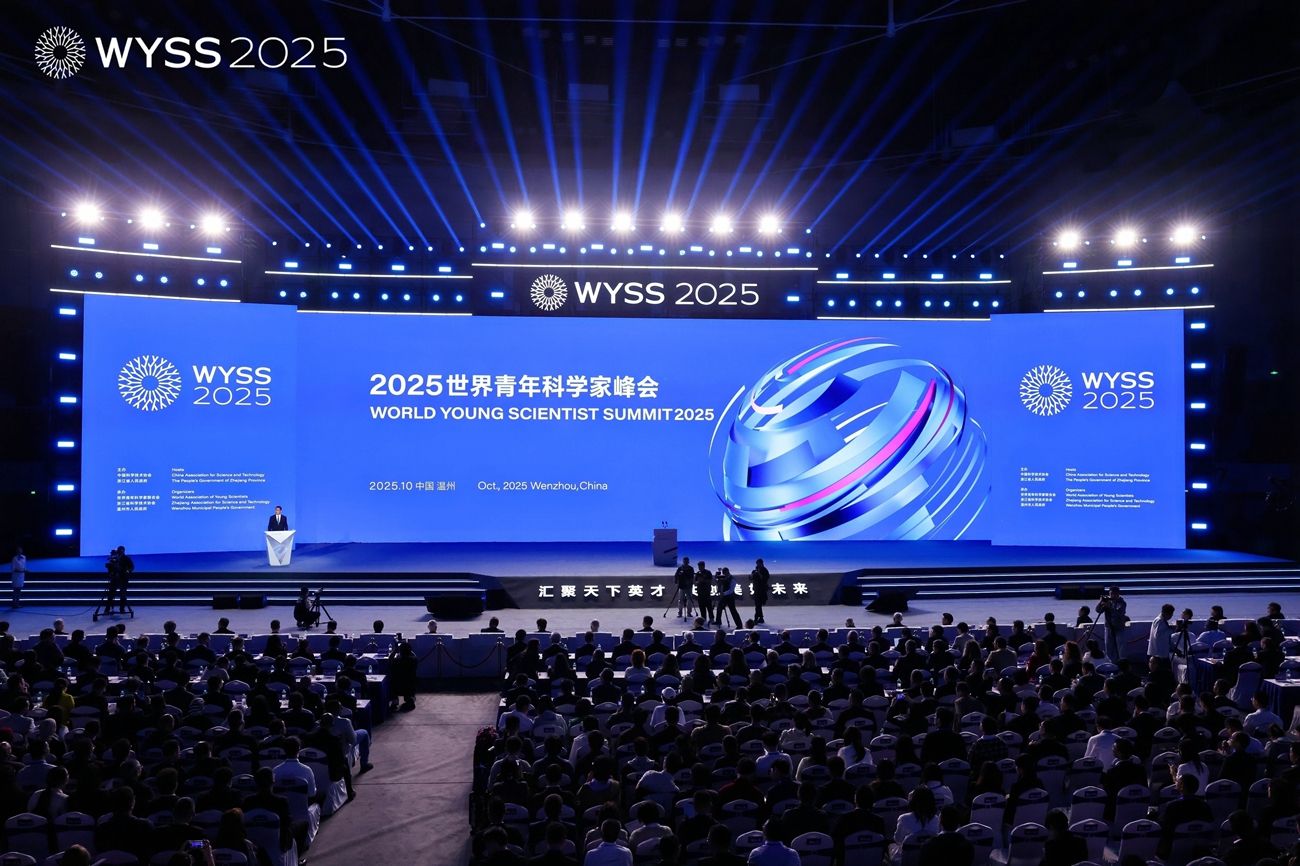
The plenary session of the 2025 World Young Scientist Summit is held in Wenzhou, Zhejiang province, Oct. 25, 2025. [Photo courtesy of the 2025 WYSS Organizing Committee]
The event was cohosted by the China Association for Science and Technology (CAST) and the People's Government of Zhejiang Province, marking the seventh edition of the summit since its launch in 2019.
Key plenary speakers included Feng Shenhong, deputy secretary of CAST's Leading Party Members Group and CAST vice president; Wang Cheng, deputy secretary of the CPC Zhejiang Provincial Committee; Donald Bruce Dingwell, president of the Academia Europaea and foreign member of the Chinese Academy of Sciences; and Zhang Zhenfeng, deputy governor of Zhejiang Province and secretary of the CPC Wenzhou Municipal Committee.
Empowering young scientists for global innovation
Feng Shenhong urged young scientists to lead independent innovation in frontier fields such as artificial intelligence, quantum information, nuclear fusion energy, and biomanufacturing. He encouraged them to apply science for the greater good, align progress with human welfare and nature, and champion open cooperation through the World Association of Young Scientists (WAYS).
Wang Cheng highlighted Zhejiang's goals to build an AI innovation hub, advance integrated reform in education, science, and talent, and accelerate tech–industry convergence. "We will play a more proactive role in the global innovation network and build an innovative Zhejiang," he said.
Dingwell stressed the need for an inclusive environment to nurture young talent, advocating broader, more integrated cooperation and robust policy support to strengthen global talent exchange and knowledge networks.
This was followed by Zhang Zhenfeng who presented Wenzhou's vision of becoming a city of innovation. A location where new opportunities in frontier science can be explored, thus creating a place where young scientists from around the world are eager to live, work and grow.
Young Scientist Sustainable Development Goals Award winners announced
At the plenary session, the 2025 Young Scientist Sustainable Development Goals Award was presented. Founded by WAYS, the Wenzhou Growth Foundation for Young Scientists and the Global SDGs and Leadership Development Center, the award recognizes outstanding young researchers who have made significant contributions toward achieving the United Nations Sustainable Development Goals (SDGs). The award goes to applications related eight areas from the United Nations SDGs and winners each receive a pre-tax 1 million-yuan ($141,000) prize.
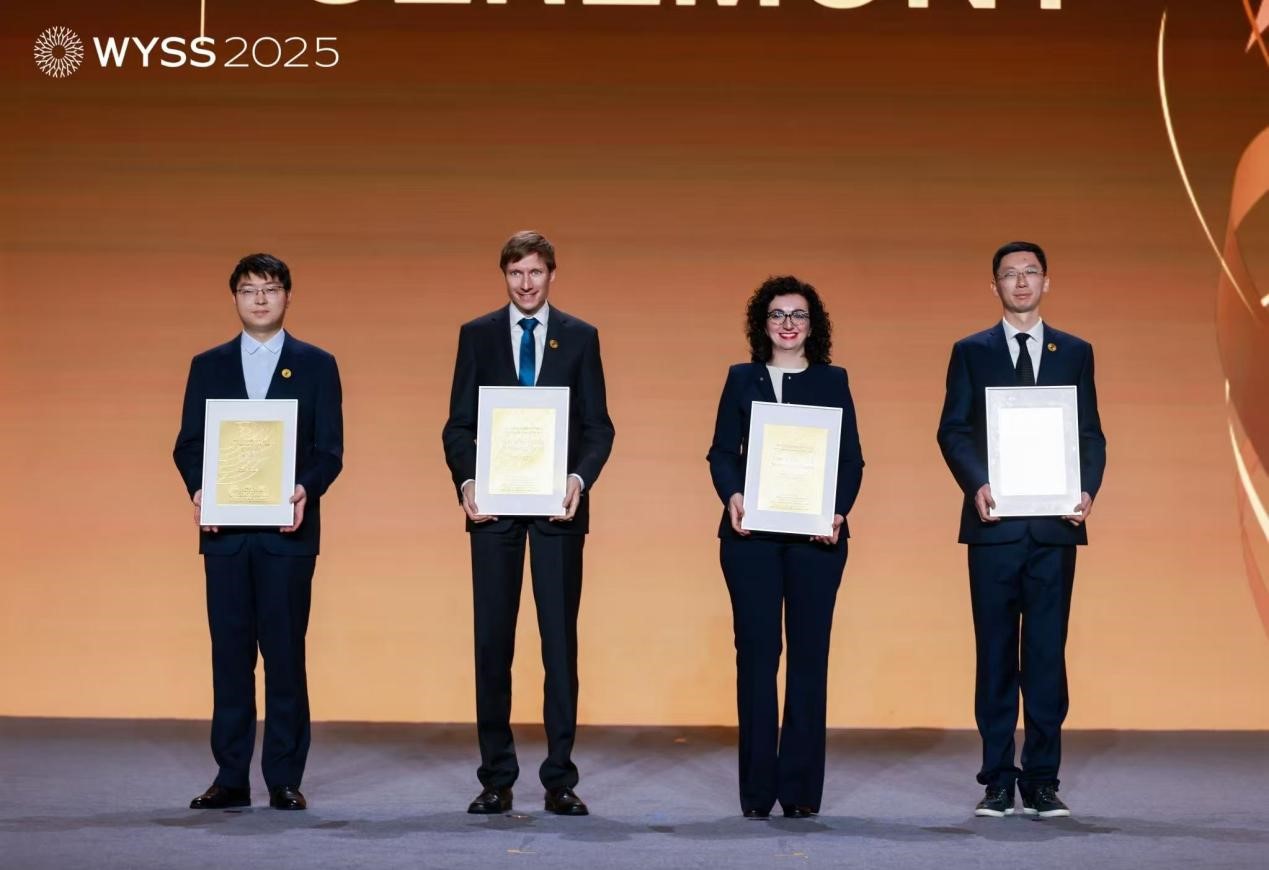
From left to right, winners of the 2025 Young Scientist Sustainable Development Goals Award pose for a group photo: Wang Hui, Wolfgang Tress, Mariangela Russo and Liu Yingjun on stage at the 2025 World Young Scientist Summit in Wenzhou, Zhejiang province, Oct. 25, 2025. [Photo courtesy of the 2025 WYSS Organizing Committee]
This year's laureates are as follows: Liu Yingjun, co-founder and CTO of Porotech (UK), for pioneering wafer-scale porous semiconductor technology, breaking manufacturing bottlenecks in microLED displays and promoting green circular innovation in the semiconductor industry.
Mariangela Russo, professor at the University of Turin (Italy), for uncovering the stress response mechanism in colorectal cancer cells and proposing personalized therapeutic strategies that advance global cancer research collaboration.
Wolfgang Tress, professor at the Zurich University of Applied Sciences (Switzerland), for pioneering studies on perovskite photovoltaic materials, driving open data sharing and advancing high-efficiency, low-cost solar energy solutions.
Wang Hui, professor at the University of Science and Technology of China, for key contributions to the "Jiuzhang" photonic quantum computer, creating a low-energy quantum infrastructure and introducing a more environmentally friendly computing paradigm.
Reports and initiatives released
Several major reports were released at the summit, including a Survey Report on Global Early-Career Young Scientists' Growth and Development, a study on the Global Distribution and Mobility of Young Scientists in AI, and the launch of the Global Young Scientist Pioneers Under 35 (WAYS-2035) list to recognize emerging leaders.
The event also introduced the Global Young Scientists Innovation and Entrepreneurship Growth Support Program, which includes co-publishing an international journal with Institute of Physics Publishing (UK), joint nuclear science talent training programs with the China National Nuclear Industry Joint Graduate School, a sector-specific enterprise support initiative with listed companies, and the WYSS Venture Fund Alliance to foster global science-based entrepreneurship.
Keynote speakers and forums
Distinguished speakers included Arieh Warshel, 2013 Nobel Laureate in Chemistry and member of the U.S. National Academy of Sciences; Qiao Jie, executive vice president of Peking University and academician of the Chinese Academy of Engineering; Wei Gao, president of the International Society of Nanomanufacturing and academician of the Engineering Academy of Japan; Yu Dapeng, academician of the Chinese Academy of Sciences and president of the Shenzhen International Quantum Academy; and Li Junfeng, vice president of Huawei Technologies Co., Ltd.
During the Quickfire Talks session under the summit's annual topic "Embracing Change: Young Scientists Shaping the Future Together," speakers including Zhang Rui, chairman of Beijing ARTROBOT Technology Co., Ltd.; Andy Soder Anker, postdoctoral researcher at the Technical University of Denmark; Xu Jiajia, CEO of Lingyang Industrial Internet Co., Ltd.; and award winner Mariangela Russo shared insights into innovation, entrepreneurship and the responsibilities of young scientists in a rapidly evolving technological landscape.
Expanding openness and cooperation
This year's WYSS featured 11 parallel forums focusing on frontier scientific innovation, young scientist development, and integration of scientific and industrial innovation. The summit also hosted the "Universal Gravitation π" Showcase and Exchange Event and multiple regional extension activities.
Since its inception in 2019, the WYSS has become one of China's most influential international scientific gatherings and a flagship event for youth science diplomacy. It is also a key component of CAST's "International Month 2025: Openness, Cooperation, Trust," which aims to strengthen global collaboration and mutual trust in science and technology.